

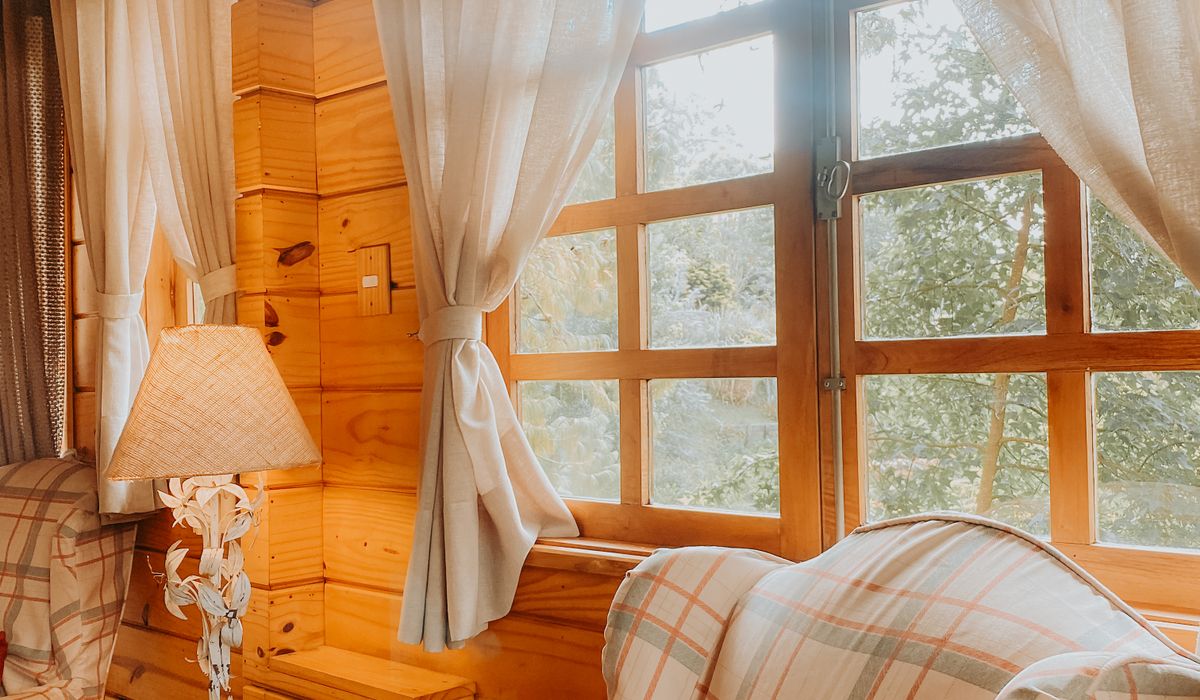
Whether you have a shepherd's hut tucked behind the house, a garden cabin at the bottom of the lawn, or a woodland retreat you escape to at weekends, the same truth applies: the smaller the space, the more every piece of furniture has to earn its place. A cabin that feels cramped is usually not short on charm — it is short on clever thinking. The good news is that small-space design is a well-trodden path, and the tricks that work in studio flats and narrowboats work beautifully under a timber roof too.
The guiding principle is simple. Anything that does only one job, and does it permanently, is taking up room you could be using. Look for pieces that fold, stack, tuck, or double up — and choose them with the same care you would give a sofa in a larger home.
In a cabin, the table is often the biggest obstacle to free movement. A drop-leaf or wall-mounted design solves this at a stroke. A gate-leg table with two leaves can seat four for a long lunch, then fold down to a narrow console barely 30cm deep against the wall, leaving a clear route from door to bed.
If you are handy with a drill, a hinged table fixed to a sturdy wall stud is one of the most satisfying projects in a small cabin. Attach it with piano hinge along its rear edge, support it with folding brackets, and add a simple latch so it stays put when raised. When it is down, the space beneath becomes somewhere to park a folding chair or a crate of logs.
Consider too the nesting side table. A set of two or three slim tables that slide under one another gives you a coffee table, a bedside surface, and a spot for a lamp without ever cluttering the floor. Choose solid timber or powder-coated steel over flimsy chipboard — cabins see damp and temperature swings that punish cheap materials.
If there is one piece of furniture that transforms a tiny cabin, it is the built-in bench. Run it along one wall, under a window, or around a corner, and you gain seating for four or five people, a deep storage void beneath the seat, and often an extra bed when topped with a good mattress cushion.
Build the base as a simple frame of 44mm timber with a plywood or tongue-and-groove top, then divide the void into bays. Lift-up lids on hinges give access from above; sliding or hinged doors on the front work better where the bench doubles as a bed. Line the bays with a breathable material rather than sealing them tight, so damp air does not linger against stored bedding.
Paint the whole thing in the same colour as the walls and it will visually recede, making the cabin feel wider than it is.
A stool that opens is a quiet hero of small-space living. Use it as a seat at the fold-away table, a footrest by the wood burner, a step to the top bunk, and a home for blankets, kindling, board games or the toolbox you keep meaning to tidy.
A well-made storage stool in plywood or oak with a lift-off lid is worth tracking down, but a sturdy wicker basket with a padded top does the job for a fraction of the price. For woodland retreats, look for something with a flat lid you can stand a mug of tea on without it wobbling.
Stackability matters as much as storage. Two or three lightweight stools that nest together can be brought out when guests arrive and tucked into a corner afterwards. Test them in the shop: sit on them properly, twist a little, and check that the joints do not flex.
Sleeping takes up more floor than anything else, so treat the bed as a design decision rather than an afterthought. A cabin bed raised on legs gives you a whole storage zone underneath — drawers, crates, or a curtained-off hanging rail for coats and boots. In a hut with a pitched roof, a low platform bed pushed into the eaves frees the centre of the room entirely.
Bunk beds are the obvious answer for family cabins, but avoid the bulky traditional frame. A simple timber bunk with a ladder that hooks on and lifts off keeps the daytime footprint small. If your cabin sleeps two, consider two singles that can be pushed together — they are far easier to manoeuvre in a tight space than one large double.
Under-bed crates on castors are cheaper than built-in drawers and just as useful. Choose ones that match the bed height exactly so nothing is wasted above them.
Furniture only does half the work. The rest comes from a few daily habits that keep a small space calm.
Get these pieces right and a cabin of eight or ten square metres will feel generous rather than tight. Measure carefully, choose pieces that fold or hide, and let the timber walls do the rest.

Snugcabin An honest, everyday look at the things that make life a little better — with advice you can actually use.

Snugcabin No rushing, no fuss — just thoughtful notes and practical help, written by people who care.

Add floor, wall, and roof insulation before considering heaters to keep your garden retreat comfortable through frosty British winters.

Comments
ALina Kelian
19th May 2018 ReplySnugcabin Real stories, useful guides and the occasional recommendation, all in one calm corner of the web. ullamco laboris nisi ut aliquip ex ea commodo consequat.
Rlex Kelian
19th May 2018 ReplySnugcabin Simple, genuine and looked after with care — the kind of place worth returning to. ullamco laboris nisi ut aliquip commodo.
Roboto Alex
21th May 2018 ReplySnugcabin No rushing, no fuss — just thoughtful notes and practical help, written by people who care. ullamco laboris nisi ut aliquip ex ea commodo consequat.